Responses
HTTP responses are the server’s reply to a client’s request, completing the request-response cycle that forms the foundation of web API communication. Every HTTP request results in a response, which contains the outcome of the requested operation along with any data or metadata the server needs to communicate back to the client. This AEP offers an educational overview of the HTTP response structure and how its components work together to communicate results effectively.
Understanding HTTP responses is essential for both consuming and building APIs. Whether you’re handling API responses in your application or designing the responses your API returns, familiarity with response structure will help you implement proper error handling, process data correctly, and build more robust integrations.
Anatomy of a Response
Section titled “Anatomy of a Response”An HTTP response looks like this:
201 CreatedContent-Type: application/jsonLocation: https://mycompany.com/api/v1/users/12345Date: Fri, 16 Jan 2026 10:30:00 GMT
{  "id": "12345",  "name": "Victor Hugo",  "email": "victor@example.com",  "createdTime": "2026-01-16T10:30:00Z"}
It has three primary parts:
- Status Line: Indicates the outcome of the request (success, fail, etc.).
- HTTP Headers: Metadata providing context for the response.
- Response Body: The data payload (optional).
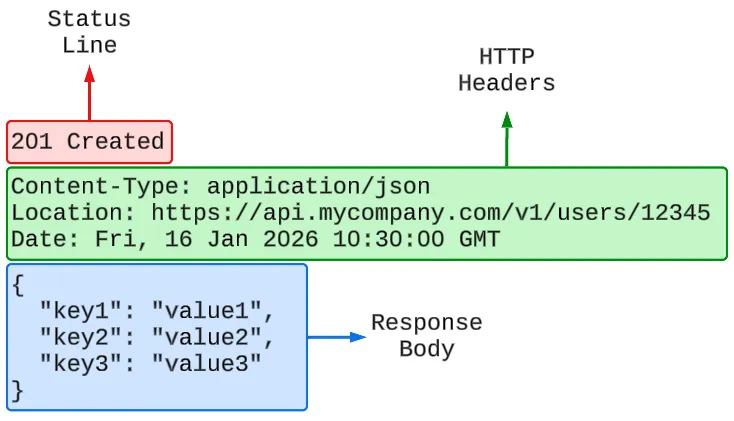
Status Line
Section titled “Status Line”The status line is the first line of an HTTP response and communicates the outcome of the request. It consists of two parts: a status code and a status message (also called the reason phrase).
For example, in 201 Created:
201is the status codeCreatedis the status message
The status code is a three-digit number that indicates the outcome of the request. Status codes are grouped into five categories, each representing a different class of response:
1xx(Informational): The request was received and is being processed2xx(Success): The request was successfully received, understood, and accepted3xx(Redirection): Further action is needed to complete the request4xx(Client Error): The request contains an error or cannot be fulfilled5xx(Server Error): The server failed to fulfill a valid request
The status message is a human-readable text description that accompanies the status code. It provides a brief explanation of what the status code means, such as “OK”, “Created”, “Not Found”, or “Internal Server Error”. While status messages are part of the HTTP specification, they are primarily informational. Clients must always use the numeric status code for programmatic decision-making, as status messages can vary between servers and are not standardized beyond common conventions.
See AEP-63 for guidance on common HTTP status codes and when to use them. For
an exhaustive reference of all possible status codes, see the MDN HTTP
Response Codes documentation. For detailed guidance on how to structure error
information when a 4xx or 5xx occurs, see AEP-193.
HTTP Headers
Section titled “HTTP Headers”HTTP headers in responses serve the same purpose as request headers: they provide metadata about the response. Response headers communicate information such as the content type being returned, caching instructions, server information, and any additional context the client needs to properly interpret the response.
Headers are organized as key-value pairs, with standardized header names defined in the HTTP specification alongside custom headers that APIs may define. Common response headers include:
Content-Type: Specifies the media type of the response body (e.g.,application/json)Content-Length: Indicates the size of the response body in bytesDate: The date and time at which the message originatedLocation: Provides the URI of a newly created resource (typically with201 Createdresponses)Cache-Control: Specifies caching directives for the responseETag: Provides a version identifier for the resource, useful for caching and conditional requests
Headers are case-insensitive, according to the HTTP specification, though
conventional formatting uses Title-Case ( e.g., Content-Type rather than
content-type or CONTENT-TYPE).
For a comprehensive reference and overview of HTTP headers, see the MDN HTTP Headers documentation. See AEP-148 for custom headers specific to our company’s APIs.
Response Body
Section titled “Response Body”The response body contains the data payload being returned by the server. This is where the server sends the requested resource, the representation of a newly created resource, error details, or any other structured data the client needs.
Not all responses include a body. For example, 204 No Content responses
explicitly indicate there is no response body. Some operations may return an
empty response body after successfully completing the operation. The presence
and content of a response body depends on the status code, HTTP method, and the
nature of the operation.
For detailed guidance on content negotiation, media types, and how clients should interpret the response body, see AEP-105. For specific guidance on structuring JSON payloads, see AEP-107. For guidance on error response formats, see AEP-193.
Changelog
Section titled “Changelog”- 2026-01-16: Initial creation.